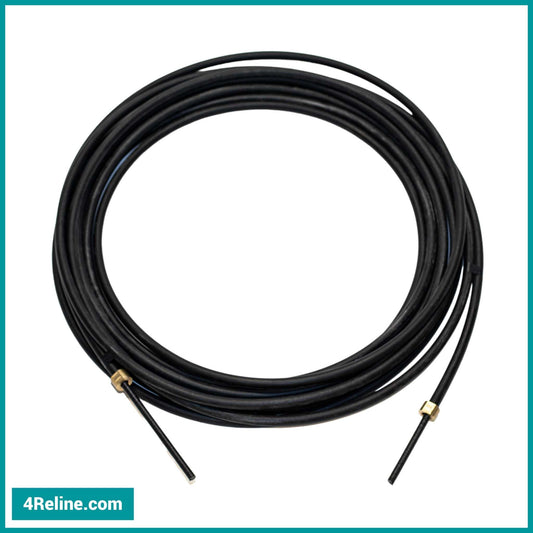
Flex Shaft Drain Cleaning Setup: What to Buy and Why

If you're getting into drain cleaning or adding it to your existing plumbing work, flex shaft setups have largely replaced the old auger approach for most common jobs. They handle both blockages and descaling, and the buying decision isn't complicated once you understand what each part does.
Here's what the full setup looks like.
What's in a Basic Flex Shaft Setup
Before getting into the individual parts, here's how the full chain of components looks from drill to pipe:
Drill → Drill to Shaft Connector → Flex Shaft → Chain Knocker (or other tool like a Milling Head)
Each part has a specific job. The drill provides the power. The drill-to-shaft connector attaches the shaft to the drill chuck. The flex shaft carries the rotation through the pipe. The chain knocker or milling head at the end does the actual cleaning or cutting.
Choosing the Right Flex Shaft
The shaft connects the drill to the cleaning tool inside the pipe. The thickness you need depends mostly on the pipe sizes you'll work with and how many bends you need to navigate.
For most drain cleaning work, 8mm (⁵⁄₁₆″) is the standard starting point. It covers the majority of jobs from DN50 (2″) branch lines up to DN100 (4″) main drains, handles pipes with bends well, and works with the widest range of compatible chain tools. It's also a safer all-around choice compared to thicker shafts because it keeps enough flexibility to navigate bends without sacrificing too much torque. Note that some suppliers and customers refer to this size as 1/3″ rather than ⁵⁄₁₆″, but they mean the same shaft.
If you're mostly doing light residential work in smaller pipes like toilets and sink traps in DN32 (1¼″) to DN50 (2″) pipes, a 6mm (¼″) shaft handles tight bends more easily. The tradeoff is less torque, which makes it better suited for clearing blockages than heavy descaling.
For commercial work with larger pipes like DN100 (4″) to DN150 (6″) and above, or for heavy descaling and liner work, a 10mm (⅜″) or 12mm (½″) shaft gives you the torque capacity those jobs need. The tradeoff is stiffness. A thicker shaft gets harder to push through tight bends, so these sizes work best in straighter runs.
One thing worth knowing: the longer the shaft, the less torque reaches the cleaning head at the other end. Most blockages occur within 20 meters, so that's a reasonable starting length for most jobs. If you need more reach occasionally, connecting two shorter shafts with a shaft connector is a practical alternative to carrying one long shaft everywhere.

Before first use, always lubricate the shaft inside the sleeve. The shafts are shipped dry because aviation regulations restrict flammable goods, so this step is on you. Check the lubrication every few weeks after that. A dry shaft wears faster and loses efficiency over longer distances.
Which Chain Knocker Do You Actually Need
The chain knockers do the cleaning. Choosing the wrong one for the pipe material is the most common beginner mistake, and it can cause real damage.
Plain chains without carbide tips are for PVC. They remove grease and soft buildup without scratching or cracking plastic pipe walls. Using a carbide chain on PVC will damage the pipe and likely cost you a repair. Carbide-tipped chains like X-Tip or Croco are for cast iron and other metal pipes. They're built for hard scale, rust, and mineral deposits. Older buildings typically have cast iron, newer ones PVC. It's worth knowing what's common in your service area before buying.

For clearing blockages like grease, debris, or roots, a drill-headed chain is the right tool. The drill head at the front bores through the obstruction while the chain cleans behind it. If you already have regular chain knockers without a drill head, a milling head attached in front of the chain gives you the same result. You don't need to buy dedicated drill-headed chains if you have milling heads available.

Circular chains are a different tool entirely. They spin outward to cover the full pipe wall and are built for descaling rather than clearing blockages. Keeping both a drill-headed setup and a circular chain in your kit means you can handle most jobs without a second trip.
What to Look for in a Drill
The chain only works if the shaft is spinning fast enough. This is where people often underinvest and then wonder why the results are inconsistent.
You want at least 70-125 Nm of torque, and the drill needs to maintain at least 1400-1500 RPM under load. Circular chains in particular depend on centrifugal force to open up properly against the pipe wall. If the drill can't hold RPM when the chain hits resistance, you end up tapping the pipe rather than cleaning it.
Anti-kickback or auto-stop protection is not optional. If the tool binds inside the pipe and the drill doesn't cut power automatically, the torque transfers straight to your wrists. Most modern cordless drills from brands like Makita, Milwaukee, or DeWalt handle flex shaft work well, as long as they meet the torque and RPM requirements above. Make sure the chuck fits at least 10mm (⅜″) to accept the shaft adapter, and don't use hammer mode. It damages the shaft connection. A drill that's slightly overpowered with good safety controls is a better choice than one that's just barely adequate. We also made separate guide for choosing the correct drill for your drain cleaning setup that we recommend checking out if you do not already have it covered.
Kit vs. Buying Separately
If you're starting from scratch, a kit removes the compatibility guesswork between shaft size and chain attachment, which is easy to get wrong when you're unfamiliar with the system. 4Reline offers four drain cleaning kits, each built around a specific shaft thickness with matching chains and tools:
- Drain Cleaning Kit, High Flexibility 6mm (¼″), for tight bends and smaller pipes
- Drain Cleaning Kit, Balanced Power 8mm (⁵⁄₁₆″), the all-around choice for most drain cleaning work
- Drain Cleaning Kit, High Torque 10mm (⅜″), for larger pipes and heavier descaling
- Drain Cleaning Kit, Maximum Torque 12mm (½″), for the most demanding jobs and liner work
If you're not sure which to pick, the Balanced Power kit covers the widest range of everyday jobs.

If you already have some equipment and just need specific parts, the flexible shaft sets and individual chain knockers are available separately as well. A shaft connector lets you combine two shafts when you need extra reach or want to pair different thicknesses on the same job.